
- Institutional decision-making, who decides, on what evidence, how fast, and with what accountability, matters more than the dashboard itself.
- Most preschools still decide reactively, acting only after fees are overdue or seats are already empty.
- Good preschool ERP software moves decisions earlier in time and outward to branch heads through role-based access.
- The next horizon is predictive and prescriptive decisioning, which only works if today’s data lives in one connected model.
- Faster, distributed decisions need guardrails: a single source of truth, audit trails, RBAC, and human oversight of AI.
It is Friday afternoon, and the director of three preschool branches is on the phone again, chasing fees that went overdue three weeks ago. She ranks her branches in her head, not on paper, by which head seems on top of things. She is already planning the next admissions push, timed by a gut feeling about when parents start looking. She is not short on effort. She is short on timing.
Here is the thing most owners miss. Her problem is not that she lacks data. Her problem is when the decisions get made, and by whom. This is a question about institutional decision-making, not about reporting. A prettier report would not save her Friday.
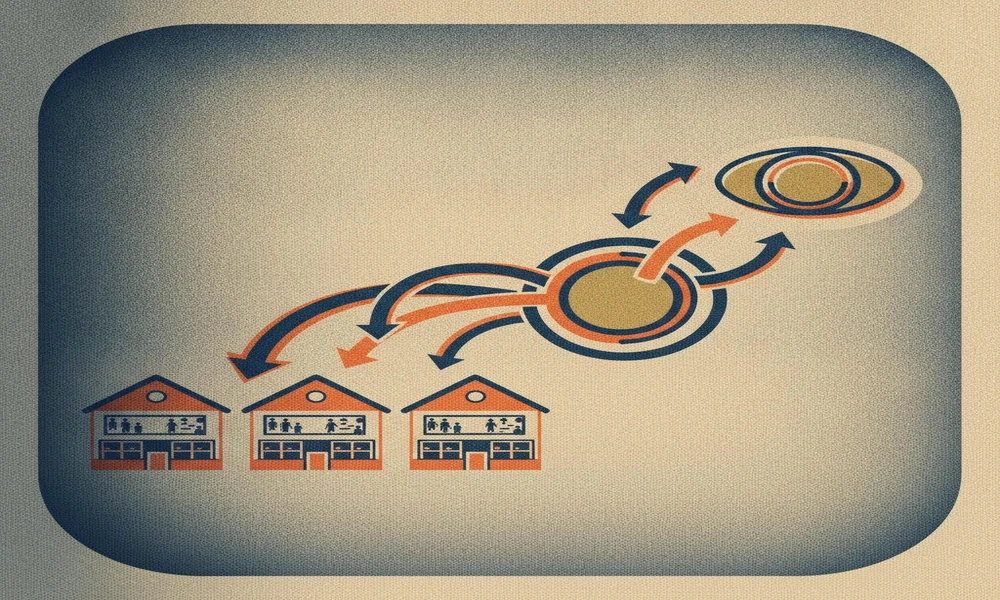
Most owners size up preschool software as an admin tool: fewer registers, faster receipts, tidy dashboards. That framing sells the least valuable part. The real effect of good software is on how the institution decides. It moves the school from reacting to last month’s numbers toward anticipating next month’s. It moves decisions away from a single bottleneck, the owner, and out to the people closest to each branch.
That is the argument of this piece. We will look at how preschools decide today, what ERP changes right now, where decision-making is heading over the next few years, and how to keep faster decisions trustworthy.
Why institutional decision-making, not the dashboard, moves outcomes
Let’s define the term in plain words. Institutional decision-making is the set of habits that answer four questions: who decides, on what evidence, how fast, and with what accountability. That is the decision layer. It is not the same as data.
Dashboards and reports describe the past. They tell you what already happened. The decision layer is what you actually do with that information, and how quickly you do it. A beautiful monthly report that still lands on the owner’s desk once a month, and waits for the owner to act, has not changed the school’s decision-making at all. It has just made the same slow loop look nicer.
Does the decision layer really move outcomes? The evidence says yes. A 2011 study of 179 large firms found that companies using data-driven decision-making had output and productivity roughly 5 to 6 percent higher than expected given their other IT spending, with gains showing up in return on equity and market value too. It is older, cross-industry evidence, not a preschool study. But the direction is steady, and it points at the same place: the decision, not the display, is what pays.
Now the honest counter-view. A skeptic says software is admin plumbing, and the owner still makes the real calls on gut and relationships. Dashboards, they argue, just add noise. That is true in one small school where the owner sees everything. It breaks the moment you run three branches. Gut-feel cannot be shared, checked, or repeated across sites. You cannot delegate a hunch.
How most preschools still decide today: after the money is already late
Picture the decision loop in a school run on spreadsheets, paper, and WhatsApp groups:
- Fee reminders go out after the payment is already overdue.
- Branch performance gets judged on the owner’s feel for which head sounds confident on a call.
- The admissions push starts on instinct, not on how the enquiry pipeline is actually filling up.
The problem runs deeper than mess. This loop is reactive by design. The data exists, but it arrives late and scattered across chats, notebooks, and separate sheets, so every decision becomes a response to a problem that has already cost money. This is management by exception done blind. You find the exception only after it has hurt you.
Occupancy is the clearest example of a signal seen too late. In early education, occupancy is a real-time number, not a year-end one. Operators who watch it closely treat about 85 percent as standard and 95 percent as the mark of a well-run setting. Any week your occupancy sits below the budgeted target, the program is quietly losing money that week. If you only notice at term end, the loss is already booked.
Here is the blunt part. The tool most preschools reach for, generic preschool management software bolted onto old habits, often just digitizes the same late, owner-dependent loop. The receipts are cleaner. The decision still happens at the same slow moment, on the same one desk.
From reactive to anticipatory: what preschool ERP software changes right now
A real preschool ERP software platform does more than report faster. It moves the decision earlier in time. That shift shows up in three live signals:
- Fee ageing and DSO. The system flags accounts drifting toward overdue before the due date passes. The nudge goes out while it can still prevent the arrears, not after the money is gone.
- Occupancy and the admissions funnel. Weekly occupancy by classroom, plus a visible enquiry-to-admission pipeline, lets you start the next admissions push when the pipeline thins. Not when the seats are already empty.
- Attendance signals. A child’s attendance quietly dropping surfaces as an at-risk flag. That turns a future withdrawal into a conversation you have this week, while the family is still reachable.
There is a name for this habit, and it is old and well tested. W. Edwards Deming built the Plan-Do-Study-Act cycle around prediction. He deliberately chose Study over Check to stress predicting the result of a change, studying the actual result, and revising the theory, over and over, testing small before rolling out wide. That is exactly the habit good ERP data makes possible in a preschool. You predict, you act, you compare, you adjust.
The second half of the shift is about who decides. Role-based access control, or RBAC, lets the owner hand out decision authority safely. In plain terms, each role sees and can act on only what its job needs. A branch head can chase their own fee follow-ups and act on their own occupancy without every call routing back through the owner, and without seeing other branches’ finances. That is how data-driven preschool management scales past one exhausted person.
So the decision has moved twice. Earlier in time, and outward to the right person. That is the change. Not the dashboard.
The next horizon: predictive and prescriptive decisioning in preschool ERP software
It helps to see the whole path. Reactive means you respond after the fact. Anticipatory means you act on early signals, which is where good ERP sits today. Predictive and prescriptive is the next few years. Two new words, both simple.
Predictive means the system forecasts what is likely. Projected enrollment for next term. Which families look at risk of not re-enrolling. The seasonal dip in cash flow before it arrives.
Prescriptive goes one step further and suggests the move. Contact these at-risk families first. Change this fee structure now to protect your margin next quarter.
Make it concrete with the highest-stakes call an operator ever faces: opening a new branch. Today that is usually a gut decision with a lot of money behind it. With a mature data model, it becomes scenario planning. You model the expected enrollment ramp, the break-even occupancy, and the staffing you will need, all before you sign the lease, using the patterns your existing branches have already proven.
Here is what this means for a buyer right now. Today’s clean, connected data is the raw material for any future forecast. A system that stores data in silos can never predict well, no matter what AI someone bolts on later. If you want tomorrow’s forecasting, demand a single data model today.
And keep the point in view. The value of predictive tools is still better decisions, not a smarter screen. An AI that forecasts churn but changes nobody’s Monday morning is worthless.
Faster, more distributed decisions still need guardrails you can trust
Push decisions earlier and outward, and the institution gets faster. But faster and more distributed decisions can also go wrong faster. The guardrails are what make the speed defensible. Three matter most:
- Single source of truth. One system of record, so a branch head and the owner decide off the same numbers instead of two versions that quietly disagree.
- Audit trails and exportable records. Every fee waiver, refund, and access change is logged and can be pulled up later. A fast decision can still be explained to an auditor, a parent, or a co-founder.
- RBAC as accountability. Security is the obvious use. The quieter one matters more here: because roles are defined, you always know who was authorized to make each call.
The horizon guardrail is human oversight of AI. UNESCO’s guidance on generative AI in education calls for a human-centered, age-appropriate approach with strong data-privacy protection and coherent policy frameworks, and warns that most institutions are not yet ready to validate these tools. As preschool decisions become AI-assisted, human oversight is a prerequisite, not an afterthought.
This lands even harder in early childhood. There are almost no absolutes in this work. Every classroom is different, every child is different, and technology should enhance high-quality human interaction rather than replace it. The right question to ask of any new tool is simple: does it give us something we did not already have, without taking the teacher’s judgment off the table?
That is also how you keep trust. Be plain with educators and parents about what the system decides on its own and what a human still signs off. Data-driven preschool management without trust is just surveillance, and parents can smell the difference.
What to demand from a preschool management system today so it decides well tomorrow
Judge a preschool management system by one lens: does it strengthen the four decision questions from earlier, who decides, on what evidence, how fast, and with what accountability? Not by how many modules it lists on a sales sheet. Here is the checklist:
- One integrated data model. So decisions across admissions, fees, attendance, and academics all draw on the same numbers. A single, connected preschool management system is the foundation everything else sits on, and it is the difference between a real ERP and a pile of separate apps.
- Real-time visibility. Occupancy, fee ageing, and pipeline updated live, not compiled by hand at month end.
- Role-based access. So you can hand decision authority to branch heads safely.
- Exportable audit trails. So fast decisions stay defensible when someone asks.
- India-fit essentials. This is where local reality decides whether staff and parents actually adopt the thing.
That last point deserves a hard number. UPI crossed 707 million transactions in a single day on 2 August 2025 and now carries roughly 85 percent of India’s digital transactions, according to NPCI. A system that cannot collect fees over UPI, nudge parents on WhatsApp or SMS, and run smoothly on a mid-range Android phone is already behind its own market. Add multi-branch support as the final essential: consolidated cross-branch reporting for the owner, plus branch-scoped views for each head.
Some platforms are built around exactly these essentials. BubbleBud Kids, for example, is an India-fit digital preschool software system with an integrated data model, RBAC, UPI and WhatsApp built in, a mobile-first design, and multi-branch reporting. The point is not the brand. The point is the shape: choose tools built for how Indian preschools actually run and actually decide.
The operator’s real upgrade is from firefighter to strategist
Come back to the director from Friday afternoon. Picture the same day a year later. The overdue-fee calls did not happen, because the reminders went out before the due date. She did not rank her branches by feel, because each head already acted on their own occupancy signals during the week. Her afternoon went to next quarter’s plan, not last month’s cleanup.
So here is the recommendation, plainly. Do not evaluate preschool ERP software as an admin tool. Evaluate it by whether it changes your institutional decision-making: moving decisions earlier in time, outward to the right people, and forward from reporting the past to forecasting the future, with guardrails that keep all of it trustworthy.
The preschools that treat the decision layer as the point, and the paperwork as a side effect, are the ones that will grow calmly over the next few years. Buy for the decision, not the dashboard.
FAQs
What is the difference between preschool ERP software and basic preschool management software?
Basic preschool management software mostly digitizes admin tasks like receipts and registers. Preschool ERP software connects admissions, fees, attendance, and academics into one data model, so the school can decide earlier and delegate decisions safely instead of just recording them faster.
How does preschool ERP software actually change institutional decision-making?
It shifts decisions in two ways. First, earlier in time: live signals like fee ageing, occupancy, and attendance flag problems before they cost money. Second, outward: role-based access lets branch heads act on their own numbers without routing every call back to the owner.
What should I look for in a preschool management system today so it supports future forecasting?
Demand one integrated data model, real-time visibility, role-based access, and exportable audit trails. Clean, connected data today is the raw material for tomorrow’s predictive and prescriptive tools. A system that stores data in silos can never forecast well, whatever AI is added later.
Are faster, more distributed decisions risky for a preschool?
They can be, which is why guardrails matter. A single source of truth, exportable audit trails, and clearly defined roles keep speed defensible. As decisions become AI-assisted, human oversight stays a prerequisite, so educators and parents keep trusting how choices get made.